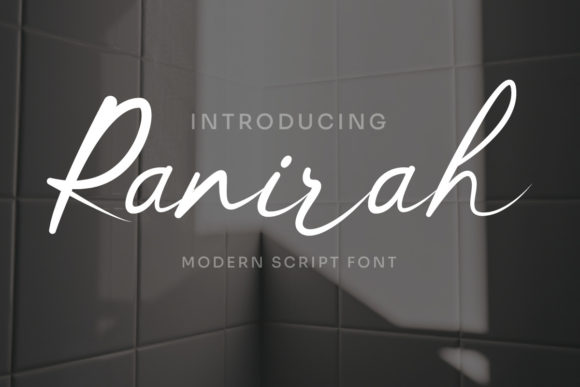
Ranirah Script Font for Elegant Handmade Branding
There’s a quiet magic in the moment you type “Lavender & Linen” into your design software and watch it bloom across the screen in Ranirah—soft, fluid, undeniably elegant. I was testing candle labels last Tuesday: matte kraft sticker paper, gold foil accents, and that delicate swirl of Ranirah tracing the scent name just above the wax pour line. It wasn’t just text—it was tone, texture, intention. That’s the power of a truly refined Script Handwritten font like Ranirah: it doesn’t sit on your product—it lives there.
Ranirah for Wedding Invitations and Elegant Branding
When I designed a set of wedding welcome boards for a client’s vineyard ceremony, Ranirah became the quiet anchor of the entire suite. Its graceful entry strokes and balanced spacing gave hand-calligraphed warmth without sacrificing modern clarity—perfect for names, dates, and venue details printed on textured cotton cardstock. As a Fonts choice for wedding stationery, Ranirah works best for headings, monograms, and short phrases (think “Mr. & Mrs. Hayes” or “Join Us June 14”). It’s not built for dense body copy—but then again, neither are wedding invitations. Let it shine where attention lands first: the envelope liner, the belly band, the acrylic place card. Paired with a clean sans serif like Montserrat Light for addresses and RSVP details, Ranirah elevates the whole experience—refined, intentional, deeply personal.
Ranirah for Handmade Candle Labels and Boutique Packaging
I’ll be honest—I tested three fonts before landing on Ranirah for my small-batch soy candle line. The first two felt either too stiff or too fussy. Ranirah struck the rare balance: luxurious but approachable, decorative but legible at 12pt on a 2” x 3” label. For candle labels, I use it exclusively for fragrance names (“Honeycomb & Sage,” “Rainwashed Linen”) and brand initials—never ingredients or safety warnings (those go in a crisp, readable sans). Because Ranirah is a true Script Handwritten typeface, its natural rhythm mimics ink on paper, which subconsciously signals craftsmanship. When printed on recycled kraft or soft-touch matte stock, it reads as *made*, not mass-produced. Pro tip: always convert to outlines before sending to your printer—or if using Cricut Design Space or Silhouette Studio, check that swashes and ligatures render cleanly at your cut size. Most versions of Ranirah include alternate characters and contextual swashes, so test a few variations before finalizing your label mockup.
Ranirah for Printable Wall Art and Digital Downloads
Last month, I added a set of minimalist botanical wall prints to my Etsy shop—each featuring a single word like “Breathe,” “Rooted,” or “Still”—set in Ranirah over muted watercolor textures. The response? Immediate. Buyers commented on how “calm” and “intentional” the typography felt. That’s Ranirah doing quiet emotional work. As a Fonts asset for digital printables, it excels in display contexts: quote art, planner headers, affirmation cards, and seasonal greeting templates (think “Cozy Season” for fall or “Sunrise Mindset” for spring). Because it’s a premium Script Handwritten font, it adds perceived value instantly—no extra design flourishes needed. Just one word, centered, in Ranirah, against ample white space. For commercial use (which most Ranirah licenses allow), always verify file formats included (.OTF/.TTF), whether multilingual glyphs are supported, and if commercial redistribution rights cover your intended use—especially for editable Canva templates or SVG bundles.
Ranirah for Social Media Posts and Shop Branding
Your Instagram story isn’t just content—it’s visual continuity. That’s why I use Ranirah for all my highlight covers, limited-edition launch banners, and even custom quote graphics pinned to my shop homepage. Its modern elegance bridges handmade charm and boutique polish—ideal for makers who sell both physical goods and digital downloads. Unlike overly ornate scripts, Ranirah retains strong readability at small sizes (yes, even in 16px Instagram captions), especially when used for short, evocative phrases: “New Arrivals,” “Hand-Poured Weekly,” “Shop Small.” Pair it with a neutral sans serif for body text or pricing, and your feed gains cohesion—not clutter. As a Fonts tool for social branding, Ranirah becomes part of your voice: warm, considered, quietly confident.
Ranirah for Greeting Cards and Seasonal Stationery
For holiday tags, birthday cards, and thank-you notes, Ranirah brings handwritten sincerity without the inconsistency of actual pen-on-paper scanning. I use it for names (“To Maya,” “From the Hart Family”) and short sentiments (“Warmest Wishes,” “With Love & Light”). Its subtle contrast between thick downstrokes and airy upstrokes gives dimension—even on flat digital prints. On letterpress or foil-stamped cards, Ranirah sings. Just avoid cramming it into tight spaces: give it breathing room. And remember—Ranirah is a Script Handwritten font, not a handwriting simulation. It’s more refined than casual, more timeless than trendy. That’s why it works across seasons: equally at home on a spring shower invitation or a winter solstice greeting.
Ranirah for Tote Bags, Mugs, and Physical Merchandise
When I screen-printed a batch of linen tote bags with “Good Things Take Time” in Ranirah, the feedback was unanimous: “It feels special.” That’s the alchemy of this Fonts choice—its elegance translates beautifully to fabric, ceramic, and wood. For merchandise, stick to medium-to-large sizes (minimum 24pt for mugs, 36pt+ for totes) and avoid fine swashes that may blur during printing. Always request a physical proof first. And because Ranirah is a versatile Script Handwritten typeface, it pairs effortlessly with minimalist layouts—no need for borders, frames, or heavy backgrounds. Let the font carry the weight. Let it whisper quality, care, and craft—exactly what handmade buyers are looking for.